 |
|

|
|
|
|
|

|




|
|||||||


|
Reviews
Sony Cyber-shot DSC-V3 In a nutshell, the DSC-V3 is a compact (4.7 x 2.9 x 2.45 inches) digital camera for people who are serious about digital photography, but donât want to get into the high end or digital SLRs just yet. The new Sony offers 7.2 megapixels which translates into a maximum picture size of 3072x2304 pixels÷good enough for just about any enlargement. Unlike many other Sonys, this one looks neither futuristic nor unusual. Itâs just your basic matte-black metal body with the usual controls and a conventional looking ăpower bulge.ä This makes it easy to hold the camera which weighs just under a pound, including battery. The power bulge, by the way, doesnât hold the four AAs youâd expect from looking at it. Instead, thereâs a newly beefed-up Info-Lithium battery and both a Memory Stick/Memory Stick Pro and a Compact Flash slot. Yes, this is a Sony you can buy without losing your entire investment in Compact Flash cards. When you look at the V3 from the front it appears like itâs just a body and doesnât have a lens. But thatâs only because this camera has a built-in lens protector that opens up as soon as the camera is turned on via a clearly marked ăPowerä push button on top. The lens itself is a nice Carl Zeiss Vario Sonnar with a 4X optical zoom. Its focal length is a 34-136mm 35-mm equivalent. A VAD-VHA adapter lets you add tele or wide lenses and a number of filters. The back of the camera yields another nice surprise: an extra-large 2.5-inch LCD that makes framing and viewing pictures so much easier. At 123k pixels it is not exceptionally high-res, but itâs bright and sharp nonetheless. And although itâs listed as a standard transmissive LCD, it doesnât wash out in sunlight. Itâs fixed and canât be moved or flipped like the one on my Olympus C-5050, but thatâs no big deal. As far as controls go, weâre starting to see a certain degree of standardization on buttons and icons, and thatâs a good thing. On top, the V3 has the standard large mode dial to set the camera into automatic, program, shutter-priority, aperture-priority, manual, scene, movie or setup mode. On the back youâll find the by now also standard five-way nav control, with each of the four directional buttons doing double duty by toggling other functions, like flash modes, self-timer, macro and so on. Additional buttons toggle through LCD display, image size, manual and menu options. Itâs all pretty clear. The zoom rocker is on the back of the camera in the ergonomically perfect spot. I prefer that to Olympusâ solution of a zoom wrapped around the shutter release which must be operated with your index finger.
On the image side of things there are a number of improvements. First of all, RAW mode fans rejoice. The V3 has one, in addition to TIFF and various degrees of JPEG compression. The camera also has a MPEG Movie VX Fine mode that lets you take 640x480 movies with sound at a full 30 frames per second. That requires a Memory Stick Pro card, and even a 1GB car will only hold 12 minutes. The regular VX mode operates at 17 frames per second and a full 44 minutes fits on a 1GB card. Not bad at all. And the movie mode is excellent. Speaking of cards, the V3 has a switch to select whether you want to record onto a Memory Stick or a CF card. Good idea. The Olympus will default to whatever card was last by itself, which often happens to be a tiny xD-Picture card. Auugh. A few words here about some of the V3âs unique features. First, there is nightframing and nightshot, accessible through a push button on top of the camera. Nightshot uses infrared illumination to take a picture in the total dark. The result will be green, as if you looked through high-tech nightvision goggles. Nightframing uses IR to let you compose the picture but then takes a regular flash picture, with excellent results. A nice touch. Second, Sony uses two kinds of digital zoom. The conventional ăprecisionä zoom is just a 2X digital magnification and not very useful. The second, called ăsmart zoom,ä does not reduce image quality, but it only works when youâre in lower res modes. Thatâs because the system uses extra pixels that you donât use in the lower res modes. If you shoot in 640x480 you can ăsmart zoomä up to an amazing 19X. The thing works remarkably well. Zoom in at almost 20X, and image stabilization is so good that the result is razor-sharp. This could come in very handy. The 5-area multi-point auto focus works well (I hate underperforming auto focus systems). In lower light situations it is assisted by Sonyâs laser-based Hologram AF Illuminator.
Sony offers a good dozen of accessories for the V3, including lenses (wide-angle, telephoto, close-up), filters, an external flash, chargers and a nice leather case. We did get a chance to test the screw-on wide end conversion and the powerful HVL-F32X external flash that has its own LCD panel, an adjustable bounce flash head, manual control, a seven inch long extension adapter with cord, and a handy carry case. For an extra $150, the F32X flash is a must have. The lens brings the wide angle down to 23.8 millimeters. Unfortunately, the lens barrel blocks part of the optical viewfinder and also renders the internal flash near unusable. A nicely made two-part rigid leather case costs $60. It should be on your list of accessories to buy with the V3. On the software side, Sony includes Picture Package for Windows and Image Data Converter, both of which are fairly basic. Mac users get ImageMixer and Image Data Converter. Sony often gets carried away in its quest to push the limits, both in technology and in design. With the Cyber-shot DSC-V3 they created a camera thatâs almost understated, but one that beautifully combines technology, ergonomics, features, and performance in a compelling, useful package. One of the yearâs best. ÷Conrad
H. Blickenstorfer |
||||||
|
|
|||||||
|
©
2004 D.C. Publications, Inc. All Rights Reserved. |
|||||||
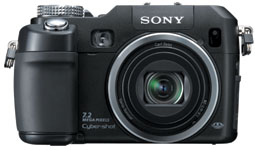 So
there I walk into my office and see my trusted Olympus C-5050 Zoom
sitting on my desk, the one that Iâm using for most of my product
shots, my daily driver. I love that camera. Nice, compact black
body and everything works right. But wait, something doesnât look
quite right. Hey, thatâs not my Olympus, itâs a·., itâs a SONY!
Yes, executive editor MacNeill had decided to give me an early Christmas
present by letting me review the then almost brand-spanking new
Sony. I quickly found that though it looks like an Olympus, the
main target in Sonyâs razor-sharp crosshairs was the mighty Canon
G6. Though they donât look the same, they share many specs and features.
In its own lineage, the V3 is the replacement of the Sony DSC-V1,
a decent enough camera but one that didnât quite seem to know if
it wanted to be a handy little compact or a serious camera. It had
a sleek little silver body that just couldnât accommodate all the
stuff needed to run with the big dogs. As a result, we didnât like
it very much, and apparently Sony came to the same conclusion÷a
new approach was needed. Even if that meant that for once a new
model was going to be larger and heavier instead of smaller and
lighter.
So
there I walk into my office and see my trusted Olympus C-5050 Zoom
sitting on my desk, the one that Iâm using for most of my product
shots, my daily driver. I love that camera. Nice, compact black
body and everything works right. But wait, something doesnât look
quite right. Hey, thatâs not my Olympus, itâs a·., itâs a SONY!
Yes, executive editor MacNeill had decided to give me an early Christmas
present by letting me review the then almost brand-spanking new
Sony. I quickly found that though it looks like an Olympus, the
main target in Sonyâs razor-sharp crosshairs was the mighty Canon
G6. Though they donât look the same, they share many specs and features.
In its own lineage, the V3 is the replacement of the Sony DSC-V1,
a decent enough camera but one that didnât quite seem to know if
it wanted to be a handy little compact or a serious camera. It had
a sleek little silver body that just couldnât accommodate all the
stuff needed to run with the big dogs. As a result, we didnât like
it very much, and apparently Sony came to the same conclusion÷a
new approach was needed. Even if that meant that for once a new
model was going to be larger and heavier instead of smaller and
lighter. 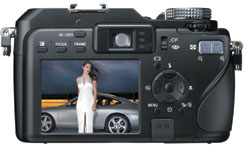 There
are some little glitches and omissions. The optical viewfinder doesnât
have a diopter adjustment, so if your eyesight isnât compatible
with it youâre out of look. The flash is a tiny little pop-up thing
with an effective range of just over eight feet. It does, however,
pop up automatically when its services are called for (some cameras
require manual pop-up before the flash will work). The V3 has a
more powerful battery than the wimpy one in the V1, but itâs still
only 4.4 watt-hours, much less than most of the competition in this
class. However, Sonyâs InfoLithium technology is always better than
what the specs suggest, and I love the fact that it always tells
you how many minutes you have left. Nominally itâs rated at 300
pictures with the LCD on. Iâd still get a backup battery as it takes
a while to charge a pack.
There
are some little glitches and omissions. The optical viewfinder doesnât
have a diopter adjustment, so if your eyesight isnât compatible
with it youâre out of look. The flash is a tiny little pop-up thing
with an effective range of just over eight feet. It does, however,
pop up automatically when its services are called for (some cameras
require manual pop-up before the flash will work). The V3 has a
more powerful battery than the wimpy one in the V1, but itâs still
only 4.4 watt-hours, much less than most of the competition in this
class. However, Sonyâs InfoLithium technology is always better than
what the specs suggest, and I love the fact that it always tells
you how many minutes you have left. Nominally itâs rated at 300
pictures with the LCD on. Iâd still get a backup battery as it takes
a while to charge a pack.