 |
|

|
|
|
|
|

|




|
|||||||


|
Reviews
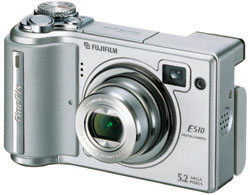
Fujifilm FinePix E510 The E Series announcement actually consisted of three new cameras, the FinePix E500 and E510 that differ only in their megapixel counts÷4.1 and 5.2, respectively÷the 6.3 megapixel F550 is a more sophisticated and considerably more expensive model. The subject of this brief review is the Fujifilm FinePix E510, which is an attractively styled little camera that sits just between compact and ultra-compact. Because of a pronounced ãpower bulgeä that houses the battery and other protrusions, this is not one of those really tiny things that you can slip into any pocket. However, with a footprint of just 4 x 2.4 inches and a weight just over six ounces, itâs small and handy enough to take anywhere. At US$349 the 5.2 megapixel E510 costs $50 more than the 4.1 megapixel E500, a very small price to pay for having the extra pixel capacity. We can really see no reason why weâd recommend the lower capacity model over the E510 to anyone.
As far as operation goes, the E510 is a shining example for almost anyone else out there. All controls are well designed, properly placed and clearly marked. There is actually a ãbackä button so that you donât have to guess. Functions are logically grouped. There is, for example, a switch to toggle between taking pictures and playback. That makes a lot more sense than shoehorning ãplaybackä onto an already cluttered mode dial. Onscreen menus are equally well designed. They are clear, attractive, and self-explanatory. And even during shooting, the LCD is not cluttered with a bunch of indecipherable data. Instead, the E510 simply displays whatâs important to know. All in all, this camera is a model in sensible simplicity. However, that does not mean itâs just a simple point&shooter for beginners. It can be that, but it also has considerable power for those who like to be in control. There are shutter and aperture priority modes and also a full manual mode. Some people, though not all, may also be attracted to the E510 for its somewhat unusual 28-91mm equivalent zoom lens. Such a wide angle-lens opens up the picture quite a bit, making it easier to take group shots and such (or capture the backside of editor-in-chief MacNeillâs Mini Cooper S). As far as picture quality goes, the E510 lived up to my expectations and then some. The auto focus is reliable, images are sharp, and there is no purple fringing. Just the way I like it. öConrad
Blickenstorfer
|
||||||
|
|
|||||||
|
©
2004 D.C. Publications, Inc. All Rights Reserved. |
|||||||
 Just
like Kodak, Fujifilm is facing a painful transition from film to
digital. Whereas those two film giants once duked it out amongst
themselves, both now fight for survival in the much more crowded
field of digital imaging. But whereas Kodak jumped on high-end cameras
early on and then added a lineup of low-end digicams, Fujifilm has
always had not only high end models, but also a nice selection of
competent midrange shooters. Those are now joined by the new E Series,
announced in July of 2004.
Just
like Kodak, Fujifilm is facing a painful transition from film to
digital. Whereas those two film giants once duked it out amongst
themselves, both now fight for survival in the much more crowded
field of digital imaging. But whereas Kodak jumped on high-end cameras
early on and then added a lineup of low-end digicams, Fujifilm has
always had not only high end models, but also a nice selection of
competent midrange shooters. Those are now joined by the new E Series,
announced in July of 2004. 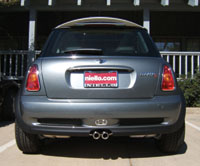 Right
off the bat, the E510 has a lot going for it. Although it is small,
its handsome matte-silver metallic body fits much better into your
hands than some of those credit card sized affairs I am always afraid
I drop. Iâve always liked cameras with a ãpower bulgeä because they
fit so well into oneâs hand. Another area where the E510 excels
is in its large 2.0-inch LCD display. I absolutely hate tiny displays
as they negate one of a digital cameraâs biggest advantages, the
ability to clearly see a picture before you take it and then afterwards.
You canât do that on low-res 1.5-inch displays. The E510âs large
and hi-res (154k pixels) display is a pleasure to use, and though
it is not totally transflective, it does remain visible outdoors.
Yet another big plus is that the camera uses standard AA batteries,
either alkalines, lithiums, or rechargeables. A couple of little
glitches here: Despite the sizeable power bulge that looks like
it could accommodate four batteries, it actually only holds two.
Not a lot to power that big screen. A second problem is that the
batteries donât have a retainer and thus easily fall out when you
open the door to replace the xD -Picture Card sitting in the same
compartment. As long as weâre talking glitches, it makes no sense
to me to have a plastic plug for all the important ports that is
loose and not connected to the camera. The size of a memory card
certainly isnât a consideration when picking a camera, but it still
doesnât make much sense to me to include a tiny-capacity 16MB card
with a 5 megapixel camera.
Right
off the bat, the E510 has a lot going for it. Although it is small,
its handsome matte-silver metallic body fits much better into your
hands than some of those credit card sized affairs I am always afraid
I drop. Iâve always liked cameras with a ãpower bulgeä because they
fit so well into oneâs hand. Another area where the E510 excels
is in its large 2.0-inch LCD display. I absolutely hate tiny displays
as they negate one of a digital cameraâs biggest advantages, the
ability to clearly see a picture before you take it and then afterwards.
You canât do that on low-res 1.5-inch displays. The E510âs large
and hi-res (154k pixels) display is a pleasure to use, and though
it is not totally transflective, it does remain visible outdoors.
Yet another big plus is that the camera uses standard AA batteries,
either alkalines, lithiums, or rechargeables. A couple of little
glitches here: Despite the sizeable power bulge that looks like
it could accommodate four batteries, it actually only holds two.
Not a lot to power that big screen. A second problem is that the
batteries donât have a retainer and thus easily fall out when you
open the door to replace the xD -Picture Card sitting in the same
compartment. As long as weâre talking glitches, it makes no sense
to me to have a plastic plug for all the important ports that is
loose and not connected to the camera. The size of a memory card
certainly isnât a consideration when picking a camera, but it still
doesnât make much sense to me to include a tiny-capacity 16MB card
with a 5 megapixel camera.